

The Hidden Cost of Waiting: How Time Is Quietly Draining Value From Your Money
We usually think of losing money in obvious ways.
Fees. Charges. Bad exchange rates.
Things you can see.
But there’s another kind of loss that doesn’t show up on any receipt and most people don’t even realize it’s happening.
It’s the cost of waiting.
When you send or receive money, especially across borders, there’s often a gap between when the transaction starts and when it actually becomes usable.
You send money and it says processing.
You’re expecting payment and it’s on the way.
You complete a transaction but it’s still pending.
On the surface, everything looks fine.
But during that waiting period, something important is happening:
Your money is in limbo.
And when money is in limbo, it’s not working for you.
Think about it this way.
A freelancer completes a job and is told payment will arrive in a few days. During that time, they can’t use those funds. If exchange rates shift, the value they eventually receive may not be the same as what they expected.
A business is trying to convert currency at a favorable rate, but delays in processing mean they miss that window. By the time the transaction goes through, the rate has changed.
Someone is trying to close a deal or make a payment urgently, but the delay creates uncertainty and sometimes, missed opportunities.
None of these situations involve a visible “fee.”
But value is still being lost.
This is the part of the financial system that often goes unnoticed.
We’ve built systems that are fast enough to initiate transactions quickly, but not always efficient enough to complete them with certainty and control.
So while it feels like progress has been made, the experience still comes with friction.
And over time, that friction adds up.
There’s also a psychological side to it.
Waiting introduces doubt.
You start asking questions:
Did it go through?
Is something wrong?
When will it actually arrive?
Even when the system works as expected, the lack of clarity creates tension.
And in finance, tension usually comes from one thing, lack of trust.
It’s not just about how long it takes.
It’s about how confident you feel while it’s happening.
This is why the conversation is beginning to shift.
People are no longer satisfied with just “sending money.”
They want to know:
- When exactly it will be available
- What value they will receive
- Whether the process is secure from start to finish
Speed alone isn’t enough anymore.
Because fast transactions without structure can still carry risk. And slow transactions with uncertainty can quietly reduce value.
What people are really looking for now is something more balanced.
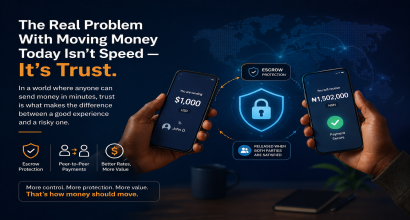
A system where transactions happen in a way that feels immediate, but also controlled. Where both sides of a transaction are protected, and where money isn’t left hanging in between steps.
This is where newer financial approaches are starting to stand out.
Instead of relying entirely on traditional processing systems, there’s a growing focus on direct transactions between users but with a layer of protection built in.
A setup where:
- Both parties agree on the terms upfront
- The transaction doesn’t rely on long processing chains
- Funds are held securely until everything is confirmed
In that kind of system, waiting is reduced, not just in time, but in uncertainty.
You’re not just moving money faster.
You’re moving it with clarity.
Platforms like PayHaven are built around this idea.
By combining peer-to-peer transactions with an escrow system, the process becomes more predictable. You’re not stuck waiting for multiple layers of processing, and you’re not exposed to unnecessary risk.
The terms are clear.
The funds are protected.
And the outcome is defined before the transaction is completed.
That alone changes the experience.
Because at the end of the day, the real issue isn’t always what you pay.
It’s what you lose while waiting.
And in a financial world that’s constantly evolving, reducing that invisible loss might be one of the most important shifts happening right now.