

How Peer-to-Peer Platforms Are Changing Cross-Border Payments
Sending and receiving money across borders has become a normal part of everyday life. From freelancers working with international clients to remote employees, online business owners, students, and families supporting loved ones abroad, cross-border payments are no longer limited to large corporations or banks.
But despite how common international transactions have become, many people still face the same frustrating problems: slow processing times, high fees, poor exchange rates, limited flexibility, and concerns about security.
This is one of the major reasons peer-to-peer (P2P) payment platforms have continued to grow in popularity around the world.
Instead of relying solely on traditional financial systems, more people are now choosing platforms that allow users to transact directly with one another in a safer, faster, and more flexible way.
What Are Peer-to-Peer Payment Platforms?
Peer-to-peer payment platforms are systems that allow individuals to exchange money directly with other users on the platform.
Rather than one central institution completely controlling pricing and transaction flow, users can interact with each other more freely. In many cases, this creates better flexibility, faster transactions, and improved rates compared to traditional methods.
P2P systems have become especially valuable in regions where access to international banking solutions can be difficult, expensive, or slow.
Today, freelancers in Africa work with clients in Europe, remote workers receive salaries from companies in the U.S., creators earn from global audiences, and online entrepreneurs run businesses that depend heavily on international payments.
As digital work continues to grow, the demand for more practical financial solutions keeps increasing.
Why Traditional Cross-Border Payments Often Frustrate Users
For years, international payments have been associated with several common issues:
High Transaction Fees
Many traditional systems charge multiple hidden fees throughout the payment process. Sometimes users lose money through conversion fees, transfer charges, intermediary bank deductions, or poor exchange rates.
Over time, these losses become significant especially for freelancers and remote workers who receive payments regularly.
Delayed Transactions
International transfers can sometimes take days before they are completed. Delays often create stress for people handling urgent payments, business transactions, tuition fees, or client-related work.
Poor Exchange Rates
A small difference in exchange rate may not seem important at first, but consistently receiving poor rates can lead to substantial financial loss over time.
For individuals who rely on foreign payments monthly, this becomes a major issue.
Limited Flexibility
Traditional systems usually provide fixed processes with little room for negotiation or personalization. Users are often forced to accept whatever rates or conditions are available.
Why More People Are Turning to P2P Platforms
Peer-to-peer platforms solve many of these challenges by creating a more user-driven experience.
Better Negotiation Opportunities
One major advantage of P2P systems is flexibility.
Instead of accepting fixed rates automatically, users can often negotiate directly with other users. This creates opportunities for better value and more competitive exchange experiences.
Faster Transactions
Many P2P transactions move faster because users interact directly rather than depending entirely on lengthy banking procedures.
This is especially useful for freelancers, remote workers, and business owners who need quick access to funds.
Accessibility
P2P platforms have made international transactions more accessible to people who may not have access to complex banking infrastructure.
For many users, all that is needed is internet access and a verified platform account.
Community-Based Transactions
P2P systems create environments where users actively participate in the transaction process rather than simply depending on a centralized structure.
This often improves transparency and gives users more control over how transactions happen.
Security Still Matters
While peer-to-peer systems offer flexibility and speed, security remains one of the biggest concerns people have when sending money online.
Many users worry about:
- Fake payment confirmations
- Fraudulent buyers or sellers
- Chargeback scams
- Unverified users
- Losing funds during transactions
This is why modern P2P platforms are increasingly focusing on protection systems that help users transact with more confidence.
One of the most important solutions being adopted is escrow protection.
How Escrow Systems Improve Trust in P2P Transactions
Escrow systems help create a layer of protection between both parties involved in a transaction.
Instead of releasing funds immediately, the platform temporarily holds the money until transaction conditions are successfully completed.
This helps reduce:
- Fraud risks
- Premature fund releases
- Transaction disputes
- Fake confirmations
For users who regularly exchange money online, escrow protection adds a level of confidence that traditional informal transactions often lack.
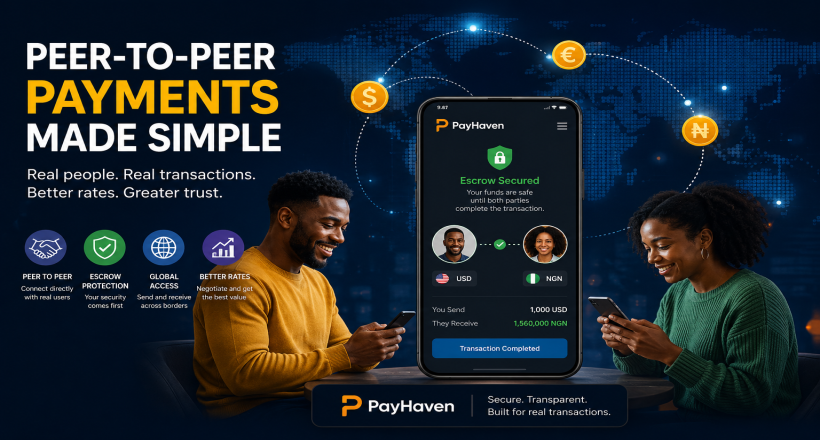
Platforms like PayHaven are helping modernize the peer-to-peer transaction experience by combining flexibility with security.
Instead of simply focusing on transactions alone, PayHaven creates an environment where users can:
- Send and receive funds more securely
- Exchange currencies through peer-to-peer interactions
- Negotiate better rates with other users
- Benefit from escrow-backed protection during transactions
For freelancers, remote workers, digital entrepreneurs, and individuals handling cross-border payments regularly, this type of system can provide both convenience and peace of mind.
As global digital work continues to expand, platforms that prioritize transparency, flexibility, and security are becoming increasingly important.
The Future of Cross-Border Payments
Cross-border payments are evolving rapidly.
People no longer want systems that are only functional, they want systems that are fast, secure, transparent, and user-friendly.
Peer-to-peer payment platforms are helping shape that future by giving users more control over how they transact globally.
As technology continues to improve and more people participate in the global digital economy, P2P financial platforms will likely play an even bigger role in how money moves around the world.
And for many users today, the goal is simple: secure transactions, better value, and financial systems they can actually trust.